Where to Find Affordable GPT-6 Access Without Breaking Your Budget
When a new generation of language models arrives, the conversation quickly shifts from "what can it do" to "how much will it cost." GPT-6 is no exception. Early adopters and small teams often face a familiar problem: the models themselves are powerful, but the pricing models from major providers can feel designed for enterprise budgets. The good news is that affordable GPT-6 access is not a fantasy. It already exists, and it works through a model that has been quietly reshaping how developers buy inference time.
The core idea is straightforward. Instead of buying API credits from a single vendor at list price, you route your requests through a marketplace of independent sellers who compete for your traffic. These sellers run their own optimized instances of the model, often on hardware they manage themselves. The result is a price that can be significantly lower than what you would pay going direct, without any sacrifice in output quality. That is the premise behind platforms that offer affordable GPT-6 access uberllm and similar services.
Why the Price Gap Exists
If you have ever wondered why the same model can cost different amounts from different providers, the answer usually comes down to infrastructure. Large providers run massive, standardized deployments. They handle peak load, redundancy, and global distribution. That convenience comes at a premium. Smaller operators, by contrast, can focus on efficiency. They might run a single well-tuned instance on specialized hardware, buying compute in bulk during off-peak hours. They pass those savings along.
There is no magic involved. It is the same model, same weights, same outputs. What changes is the cost of the electricity and the GPU cycles underneath. When you access a marketplace, your request gets routed to whichever seller offers the best combination of price and latency at that moment. The system handles the switching transparently. You send a standard API call, and the response comes back as if you were talking to a single endpoint.
What to Look for in a Marketplace
Not all marketplaces are built the same. If you are evaluating options for affordable GPT-6 access, a few factors deserve attention.
Latency and Reliability
The cheapest route is useless if it times out. Good marketplaces monitor seller performance continuously. They route around slow or failing nodes automatically. Look for a platform that provides real-time status on each seller and a fallback mechanism. If your primary seller goes down, the request should reroute without you having to code a retry loop.
Model Parity
You need assurance that the GPT-6 you get from a third-party seller is the genuine article. Reputable platforms verify the model hash and run consistency checks. They should also enforce that sellers use the official inference stack, not a quantized or distilled version that might alter behavior. If the output quality matters, and it always does, do not skip this check.
Pricing Transparency
Some marketplaces show a single blended rate. Others let you see individual seller prices and choose. The more transparent the pricing, the easier it is to predict your monthly spend. Avoid platforms that hide surcharges or add fees for high-traffic routes. The whole point of seeking affordable GPT-6 access is to control costs, not to discover new ones later.
Practical Use Cases
Affordable GPT-6 access opens doors that were previously closed to smaller teams. Consider a startup building a customer support chatbot. At list prices, the cost of running GPT-6 for every conversation might eat the entire operating margin. Through a marketplace, the same volume becomes viable. The startup can route routine queries through a cheaper seller and reserve a premium route for complex escalations. The user never notices the difference.
Another example is content generation at scale. Marketing teams that produce hundreds of product descriptions each month can cut their API bill substantially. They can also experiment more freely. When each request costs less, you can afford to try different prompts, compare outputs, and iterate faster. That kind of experimentation is exactly what leads to better results.
Researchers and hobbyists also benefit. Academic budgets are famously tight. Being able to run large-scale evaluations or fine-tuning experiments on GPT-6 without burning through a grant in a week is a real advantage. Affordable GPT-6 access uberllm and similar services have become a quiet enabler for a lot of interesting work that would otherwise be cost-prohibitive.
Caveats and Considerations
No approach is perfect. When you buy from a marketplace, you introduce a middle layer. That layer adds a small amount of latency, usually measured in milliseconds. For most applications, that is invisible. For real-time voice or interactive gaming, it might matter. Test your use case before committing.
Security is another factor. Your API requests contain data. If that data is sensitive, you need to know where it goes and who can see it. Reputable marketplaces offer encryption in transit and at rest, and they require sellers to sign agreements about data handling. Still, you should verify those policies match your compliance needs. If you work in healthcare or finance, you may need a dedicated route or a private seller arrangement.
There is also the question of support. When you pay a large provider directly, you get a support team and a service-level agreement. A marketplace distributes responsibility. If a seller goes offline, the platform should handle it, but if you have a billing dispute or a specific integration question, you might deal with a smaller team. Read the terms. Know who to call.
How to Get Started
If you are ready to try affordable GPT-6 access, the process is simple. Sign up for a marketplace platform that supports the model. Get an API key. Point your existing code at the marketplace endpoint. That is often all it takes. The interface is usually a drop-in replacement for the official API, so you do not need to rewrite your application.
Start with a small volume. Monitor the latency and the output quality. Compare it side by side with a direct connection. If everything looks good, increase your traffic gradually. Pay attention to cost trends. Some sellers adjust their prices based on demand. If you see a spike, you can switch routes manually or set a price cap in your code.
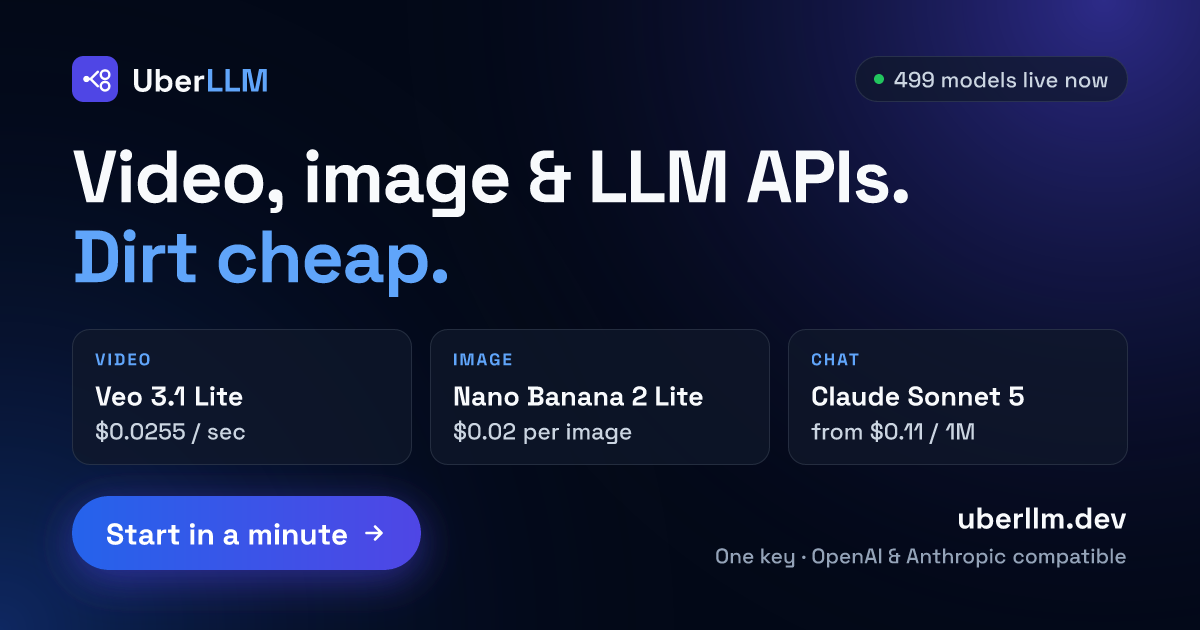
UberLLM offers exactly this kind of marketplace model. It provides a single key that works across multiple sellers, with pricing that reflects competition rather than a fixed list. The platform handles routing, failover, and seller verification, so you can focus on building your product. For teams looking for affordable GPT-6 access uberllm is worth evaluating alongside other options. The key is to test, measure, and decide based on your real usage patterns.
The Bigger Picture
The rise of marketplace pricing for large language models is part of a broader shift in how compute is bought and sold. We saw the same pattern in cloud storage, in content delivery networks, and in GPU rental. Competition drives prices down and quality up. For developers, that is a good thing. It means you are no longer locked into a single vendor's pricing strategy. You can shop around, optimize, and keep more of your budget for the things that matter: building features, serving users, and growing your business.
Affordable GPT-6 access is not a temporary deal or a limited promotion. It is a structural change in the market. The infrastructure is maturing. The sellers are becoming more sophisticated. The platforms are adding features like streaming, batching, and custom model deployments. If you have been holding off because of cost, now is the time to revisit. The landscape has shifted, and the opportunities are real.
As with any technology decision, due diligence matters. Understand the trade-offs. Test the alternatives. But do not dismiss the possibility out of hand. The same model that seemed out of reach six months ago may now fit comfortably within your budget. All it takes is a willingness to look beyond the default option.